A camera strap or tether is the line between your camera and you. This hub covers wrist straps, neck straps, harnesses and retention tethers for shooting near the sea, how to match them to your camera's weight, and how to keep buckles and clips working in salt water.
Quick answer: choose a strap by where you shoot: a wrist tether for in-water work, a neck or sling strap for beach and shore shooting, and a quick-release buckle wherever the strap could snag. Check the stated load rating against the combined weight of camera, lens and housing, and rinse all hardware after salt water.
Surf camera gear on Amazon
Sponsored
As an Amazon Associate, SurferPix earns from qualifying purchases. See our affiliate disclosure.
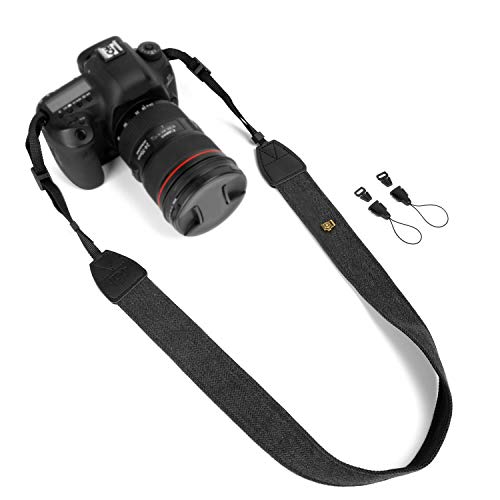
A padded neck strap with a quick-release buckle, aimed at shore photographers who want quick camera access but the option to shed the strap fast near water or crowds. Not intended for in-water use.
Reflects criteria around quick-release buckle reliability and padding comfort for longer shore sessions.
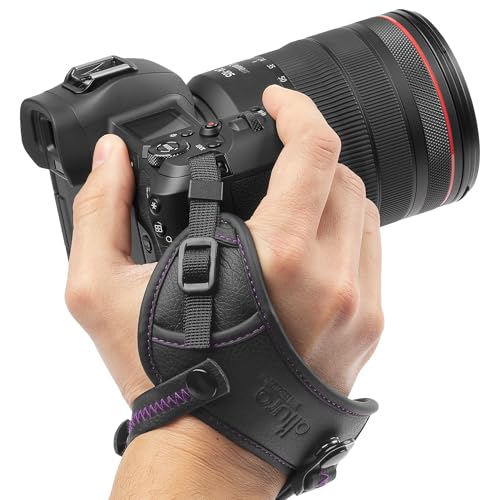
A short wrist tether aimed at in-water use where a long neck strap would create an entanglement risk near a surfboard leash or current. Preferred over a neck strap for swimming or bodysurfing sessions.
Reflects criteria around short-length entanglement safety and corrosion-resistant hardware for saltwater exposure.
A strap built around corrosion-resistant hardware rather than standard steel clips, aimed at anyone using a strap regularly in saltwater or salt-air conditions. Still benefits from rinsing hardware after sessions.
Reflects criteria around documented hardware material (avoiding standard steel) rather than an unverified 'rustproof' claim.
A cross-body sling strap for shore photographers carrying a larger camera body for extended periods, distributing weight differently than a neck strap. Better suited to shore or boardwalk shooting than in-water use.
Reflects criteria around adjustable length range and weight distribution for a larger, heavier camera body.
A camera strap carries weight and prevents drops. A tether, or retention leash, does one job: it keeps a camera attached to you, a board or a mount if it comes loose. For surf and coastal use the two jobs overlap, because a heavy camera on a beach needs a strap that spreads the weight, and a camera in the water needs a line that stops it sinking or drifting away.
The key distinction is between carrying and retaining. A comfortable neck strap is great for a long day on a headland and a poor choice in the water, where it can snag or choke. A wrist tether is the opposite. Many surf shooters use both at different times. Our guide on wrist tether versus neck strap for water-adjacent shooting helps you choose between them.
Read the table as a map of jobs. Most photographers who shoot at the coast end up with a sling or neck strap for the beach and a wrist tether for the water.
Quick-release buckles and safety
Anything that connects you to a camera near water should come off fast. A quick-release buckle lets you drop a camera or a strap that has snagged, which matters if you are pulled by a wave or a rope. Look for a buckle you can operate with wet hands and gloves, that cannot release by accident, and that is made from corrosion-resistant material.
Our guide on quick-release buckles for cameras near water goes into the trade-offs between strength and speed. In general, the strap should be strong enough to hold the camera and weak enough, or fast enough to release, that it never becomes a hazard to you. Never loop a strap around your neck while swimming, and avoid long loose ends that can wrap around fins, rocks or poles.
How to choose a strap or tether
Weigh your setup. Camera, lens, housing, mount and battery together.
Check the load rating. The maker's stated rating should comfortably exceed that weight.
Pick the position. Shore, water or board each suit a different type.
Check the attachment points. Strap lugs, tripod threads and housing loops differ. Use a point that is rated for load.
Look at the hardware. Stainless steel or coated metals, with smooth edges that do not cut webbing.
Consider length and stretch. A tether that is too long tangles; one that is too short strains the mount.
Pick a visible colour. Bright webbing is easier to spot and to untangle.
Test it on land. Pull-test and practise the release before you rely on it.
We chose not to rank straps by price or star rating. Prices move constantly, and ratings we have not gathered ourselves are not something we publish.
Pick the strap by position first, then check its rating.
Surf camera gear on Amazon
Sponsored
As an Amazon Associate, SurferPix earns from qualifying purchases. See our affiliate disclosure.
Prices and availability were accurate when retrieved from Amazon and may change. Retrieved Nov 16, 2026.
Matching the strap to the kit
A strap is only as strong as its weakest link, and that is often the attachment point, not the webbing. A small action camera on a plastic loop needs a light, flexible tether; a heavy mirrorless body with a long lens needs a wide strap and metal lugs. A housing adds weight and a different attachment: use the housing's loop or tray thread, not the camera's, since the housing is what takes the load.
When you attach a tether to a mount, connect it to the camera or housing as well as the mount base, so that if the mount lets go, the camera is still held. Keep the line short enough that it does not tangle with your leash. If you use a floating grip, add a tether as backup. Our guide to surfboard mount tethering and wave impact and the retention tethers guide explain how loads move through the line.
Compare the combined weight with the stated rating; use the maker's figures.
Common mistakes
Using a neck strap in the water. It can snag or choke.
Ignoring the load rating. A strap that is rated for a light camera may fail with a housing.
Attaching to the wrong point. Use a rated lug or loop, not a cosmetic hole.
Skipping the quick release. You must be able to shed the camera quickly.
Using a long loose tail. It tangles with fins, leashes and rocks.
Leaving salt on the hardware. Corrosion weakens clips and rings.
Assuming a tether makes a mount safe. It is a backup, not a fix.
Care in salt water
Salt corrodes metal, stiffens webbing and jams buckles. Rinse straps, clips, rings and buckles in fresh water after every salt session, working the moving parts under the flow. Dry them fully in the shade; sun fades and weakens synthetic webbing. Check stitching for fraying, webbing for cuts or stiffness, and metal for white crust or pitting. Replace any piece that shows damage, because a failing strap gives little warning.
Our guide on rinsing strap hardware after salt-water sessions lists the small parts that people forget, such as split rings and swivel clips. Store straps loosely coiled and dry, not crumpled in a damp bag, and keep a spare tether in your kit for the day yours finally gives out.
A worked example: a strap setup for a day of shore and water shooting
Consider a photographer who shoots from a headland in the morning and from the shallows in the afternoon. For the headland, a sling strap spreads the weight of a body and a long lens, with the camera riding at the hip and rising quickly to the eye. Before moving to the water, they switch to a lighter kit: a waterproof camera on a wrist tether with a quick release, plus a floating grip. The heavy kit goes into a dry bag on the sand, well above the tide line.
At each change, they check three things: that the attachment point is the right one, that the load rating covers the setup and that the quick release works with wet hands. They also keep the tail of the tether short, so it does not wrap around a fin or a leash. At the end of the day, they rinse the straps and hardware, dry them and hang them out of direct sun.
The lesson is that the strap should match the moment, not the camera. Having two simple, well-chosen tethers is better than a single universal strap that does neither job well, and the swap takes less than a minute once you have practised it.
Questions to ask before you buy
A strap or tether page should answer a handful of plain questions. What is the stated load rating, and is it a working load or a breaking strength? Which attachment points does it use, and are they suited to your camera, housing or mount? What are the hardware materials, and is the maker's note on corrosion in salt water honest? Is there a quick release, and how does it work? How long is the line, and is it adjustable? Can you buy replacement parts such as clips or sliders?
If the load rating is missing, treat the strap as suitable only for the lightest cameras. If it lists only a brand and not a camera, check the attachment shape yourself: lugs, loops and threads differ more than they look. Consider the other end of the line too. A strap that is rated for your camera but attached to a weak loop on a mount is only as strong as that loop, so look at the whole chain, from the camera to the thing you are tying to.
Finally, think about how you will use it. A tether you can fit in under a minute and release with one hand will be used. A tether that needs a tool, or that tangles in a bag, will not. The best strap is the one that is on the camera when something goes wrong, so choose for convenience as well as strength, and practise the release before you rely on it near the water.
It depends on how you carry the camera. Peak Design, for example, makes a Slide strap for shoulder or sling carry and a Cuff for the wrist, and rates each Cuff Anchor at over 200 lbs (90 kg). Pick the style that fits how you carry, then check the maker's stated rating and attachment method.
What is better, wrist wraps or straps?
Neither wins everywhere. Makers sell both: Peak Design's Cuff is a wrist strap that connects through its Anchor Link system, and its Slide is an adjustable strap for shoulder or sling carry. Choose by how you will carry and shoot, and follow the maker's guidance on fit.